Why your contractor website isn't getting calls: the 5 leaks I find in almost every audit
By Antionne Gartrell — Local Lift Studio, Clayton, NC · November 20, 2026
Listen to this article· about 5 minutes
Read aloud by Local Lift Studio — for the drive between jobs.
Watch: Why Your Website Gets No Calls: 5 Mistakes· 6:46
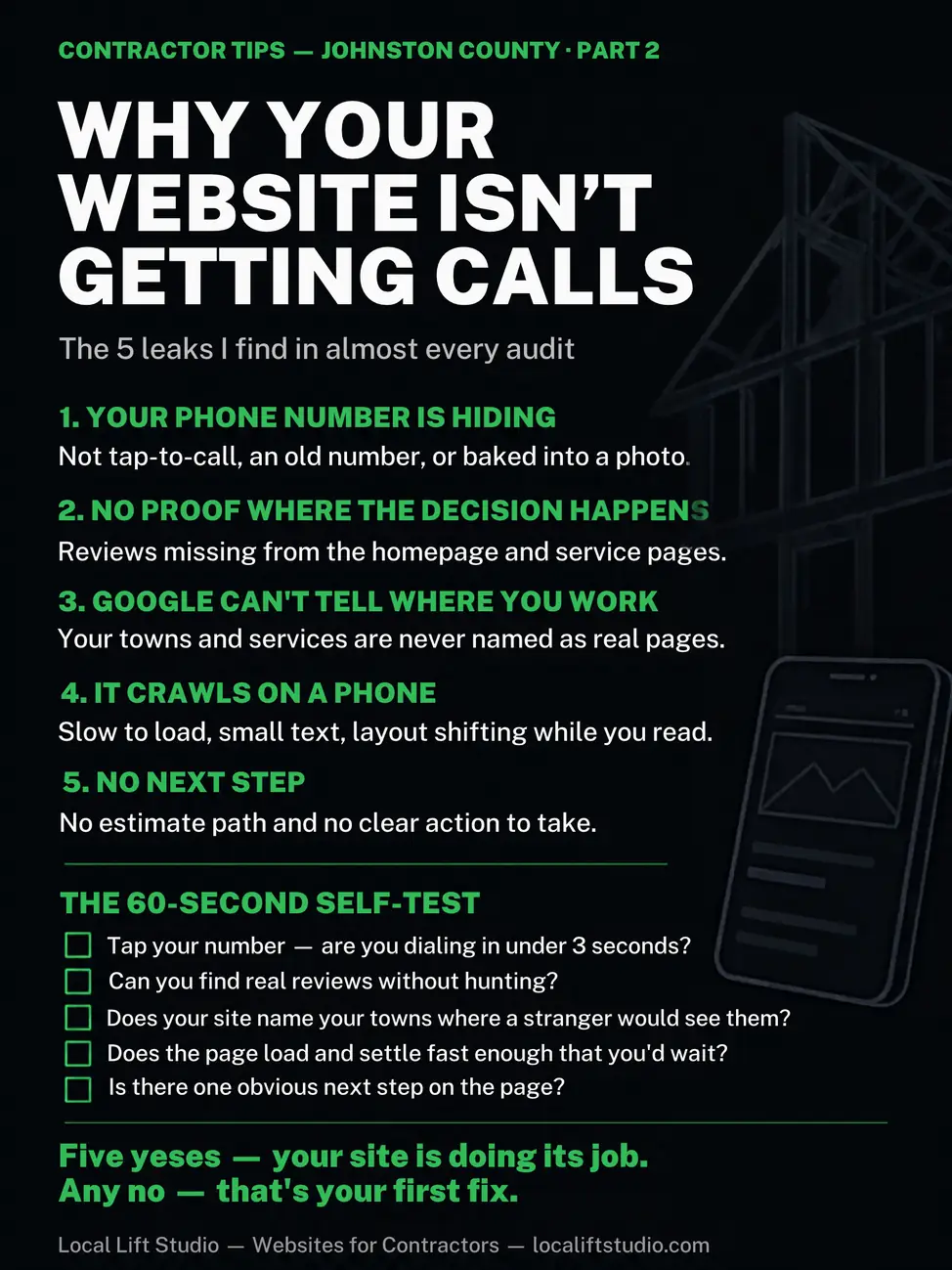
Your website is live, it looks fine — and the phone still doesn't ring. Before you blame traffic, hear this: on most contractor sites we look at in Johnston County, the visitors are coming. They're leaving without calling, for five fixable reasons — none of which needs a new website to fix.
Can a customer actually tap your number?
Leak 1: your phone number is hiding. Open your site the way a customer does — on a phone, one thumb, in a hurry. On too many sites the number is text in a footer, or only on the contact page, or tapping it does nothing. A homeowner with water coming through the ceiling is not copying your number down. She's tapping, or leaving — and the job goes to the company whose number was a button.
Watch for the quiet cousin, too: the old number from two phones ago, or a number baked into a photo. A picture of digits is not a phone number to a phone. The fix: a tap-to-call number at the top of every page — easier than leaving.
Where are your reviews when she's deciding?
Leak 2: no proof where the decision happens. When a homeowner finds two contractors who both look capable, she decides on evidence — and the evidence she trusts most is reviews. What past customers say about you carries more weight than anything you say yourself.
So where are yours? On too many sites they're nowhere, or on a testimonials page nobody clicks to — while the homepage shows a paragraph about quality workmanship. The proof is in another room. Put your reviews on the homepage, on the service pages, near the phone number. Real names, real towns, real words — the argument your happiest customers make for you while you're up on a roof.
Does Google know you work in Clayton, Smithfield, Selma and Garner?
Leak 3: Google can't tell where you work. Your site says you serve "the greater area," or names your home town once and stops. Meanwhile you run jobs in Clayton, Smithfield, Selma and Garner — but your website never says so in a way Google can use. When a homeowner in Selma searches for what you do, Google has no reason to connect her to you. It isn't punishing you. It doesn't know.
The same goes for services. One page listing everything asks Google to rank one page for four searches, and it ranks for none of them. Each town and each service deserves its own real page: your work there, your words, your proof. That's not a trick — it's telling the truth where Google looks. A site that could belong to a contractor anywhere will rank like it belongs nowhere.
What does your site feel like on her phone?
Leak 4: it crawls on a phone. Nearly every customer who finds you finds you on a phone — in a truck, on a couch, standing in the room with the problem. But a lot of sites were built for a big monitor. On a phone they're slow, the text is small, and the layout slides around as you read.
Here's the part owners miss: you rarely look at your own site on a phone, so you never feel it. Your customers feel it on every visit — and a site that makes a stressed homeowner wait and squint spends your credibility before you've said a word.
Once she believes you, what is she supposed to do next?
Leak 5: no next step. A visitor reads your site, believes you, wants a quote — and then what? On too many sites the answer is an old contact form, or nothing: no estimate path, no clear action. Interested people don't push through fog. They drift to the site that tells them what to do next.
Give every page one clear step: call this number, or request an estimate here, and say what happens next. Certainty closes. Fog doesn't. It's the same reason our pricing sits out in the open — a visitor who can see the next step, and what it costs, can actually take it.
Can you pass the 60-second self-test?
Phone in hand, timer on. Five yes-or-no questions:
- Can you tap your number and be dialing in under three seconds?
- Can you find real reviews without hunting?
- Does your site name your towns where a stranger would see them?
- Does the page load and settle fast enough that you'd wait for it?
- Is there one obvious next step on the page you're standing on?
Five yeses — your site is doing its job. Any no: you've found your first fix, and it probably isn't traffic.
Want the fuller version of that test? We keep the S-to-F website tier scorecard — the same grading we run in our own audits, on speed, clarity, the call to action, whether you actually own the site, and whether Google can place you. Run your site down it and you'll know which tier you're in, and which of the five leaks is costing you the most, before you fix a thing.
What if your phone already rings more than you can answer?
One honest word: if you're booked out on referrals and the phone rings more than you can answer, a new website is not your problem — don't let anybody sell you one.
If that's you, run the self-test first — it costs a minute. If you'd like a second set of eyes, we run a free website audit for Johnston County contractors: we walk your site as a customer does, check it against these five leaks, and tell you what we'd fix first — whether you hire us or not. Does it make sense? The visitors are already coming — the fix is stopping the leaks.