The Review System: More Real Reviews, Zero FTC or Google Trouble
By Antionne Gartrell — Local Lift Studio, Clayton, NC · November 24, 2026
Listen to this guide· about 9 minutes
Read aloud by Local Lift Studio — for the drive between jobs.
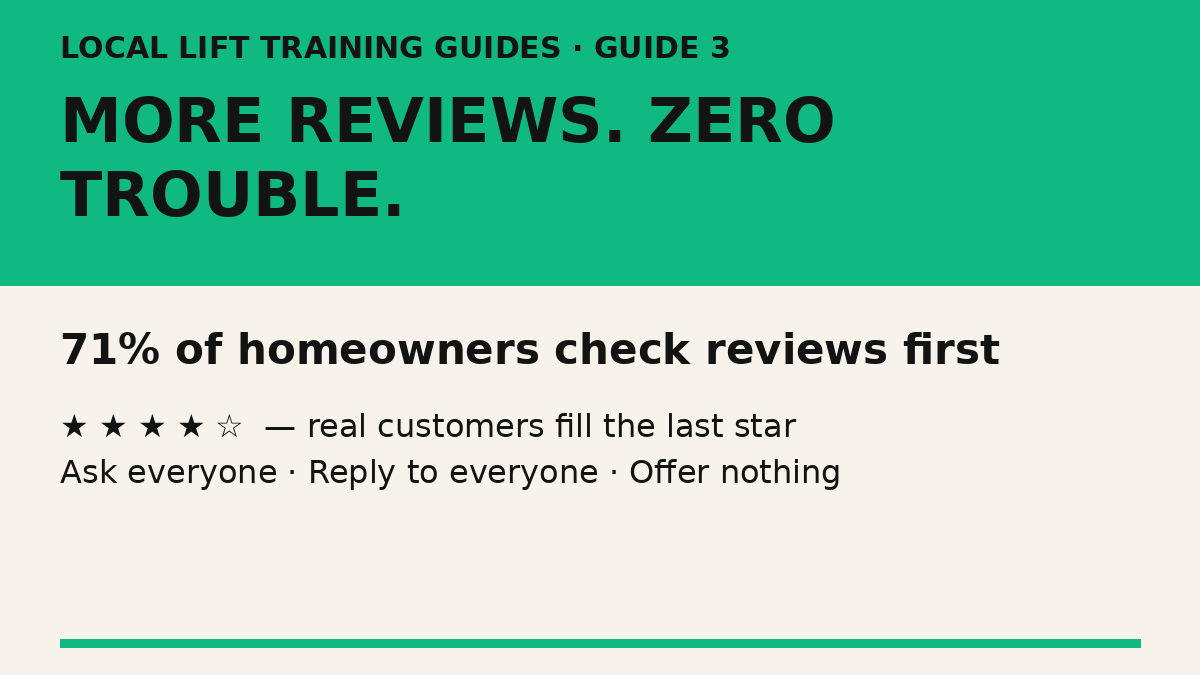
Ask every customer, reply to every review, and offer nothing in exchange — that is the whole legal review system, and it works because reviews decide who gets called. In a recent homeowner study, 71% of homeowners said online reviews are very or extremely important when choosing a contractor — yet only 48% of contractors respond to reviews on third-party sites at all. The opportunity isn't a trick. It's doing the plain, permitted things consistently while your competitors either do nothing or cut corners that can now cost them real money.
Why the rules changed — and why "everybody does it" stopped working
On October 21, 2024, the Federal Trade Commission's Consumer Reviews and Testimonials Rule — 16 CFR Part 465 — took effect. It is the first federal rule aimed squarely at fake and manipulated reviews, and it lets courts impose civil penalties for knowing violations. Habits that used to be "just marketing" — a discount for a five-star review, the tech's brother leaving a glowing write-up, a quiet word to an unhappy customer about taking a review down — now sit inside a written federal rule, on top of Google's own policy, which in several places is stricter than the FTC's.
This guide is education, not legal advice — for a situation specific to your business, an attorney is the right call. But the lines below are drawn from the FTC's own published questions and answers and Google's own policy page, both linked at the end, and they are clear enough for any shop to work inside.
What homeowners actually look for
Beyond the 71% figure above, BrightLocal's Local Consumer Review Survey 2026 (1,002 U.S. adults; BrightLocal sells review software to local businesses, so read its numbers as a vendor-run survey — the pattern matches every other source we checked) found:
- 47% of consumers won't use a business with fewer than 20 reviews.
- 74% look for reviews written in the last three months.
- 89% expect business owners to respond to reviews.
Read those three together and they describe a system, not a campaign: a steady flow of recent reviews, in real numbers, with the owner visibly answering. A burst of twenty reviews in one month followed by silence fails the second test within a quarter. That's why the ask has to be built into the end of every job — and why reviews are an owned asset that compounds, the opposite of renting leads that stop the month you stop paying.
The rules, in plain language
1. No fake reviews — ever, from anyone. The FTC rule (Section 465.2) bans writing, buying, or selling reviews that misrepresent a real customer's experience — including reviews from people who never used your business. There is no small-business exception and no "but they were a real customer once" loophole for experiences that didn't happen.
2. No paying for sentiment. Section 465.4 bans offering an incentive — money, a discount, a gift card, a prize entry — conditioned on the review expressing a particular sentiment. You cannot offer $10 off for a five-star review, even if you ask the reviewer to disclose the deal; the FTC's own guidance gives that exact example as a violation. The ban includes implied pressure: "Tell us how much you loved your visit and get a $5 coupon" is the FTC's own example of an implied condition. The FTC rule does not ban every incentive outright — an incentive with no sentiment attached is a different matter under the rule, though it still has to be disclosed. Which brings us to Google.
3. On Google, the answer is simpler: no incentives at all. Google's Maps policy bans offering any incentive — "payment, discounts, free goods and/or services" — in exchange for posting, revising, or removing a review, whatever the sentiment. Since Google is where most of your reviews live, the practical rule for your shop is the stricter one: nothing in exchange for a review, full stop.
4. Ask everyone, or accept the risk. This is where the two rulebooks split, and the split matters. The FTC's guidance says its rule contains no specific ban on asking only customers you think are happy — but warns the practice could still violate the FTC Act. Google is blunt: merchants must not "discourage or prohibit negative reviews, or selectively solicit positive reviews from customers." Selectively asking only the happy customers is called review gating, and it is banned where it counts most. The safe system is also the simple one: every customer gets asked, the same way, whatever you think they'll say.
5. Insiders must disclose — and on Google, keep them off entirely. Under Section 465.5, owners, officers, employees, and their immediate family members may only review the business with their relationship disclosed clearly and conspicuously — a disclosure a reader can't miss, not one behind a click. Google goes further: its policy treats reviews based on a conflict of interest — including current or former employment and familial relationships — as content that can be removed. Practical rule: family and crew do not review you on Google, disclosed or not.
6. No suppression. Section 465.7 bans using threats, intimidation, or unfounded legal threats to stop a review or get one taken down, and bans misrepresenting that reviews on your own site are complete when you've filtered out the negative ones. What you may do: respond publicly, contact the customer to fix the problem, and ask a satisfied customer to update their review. The FTC's guidance says so explicitly.
7. No bought applause. Section 465.8 bans buying fake followers, likes, and other indicators of social-media influence you know or should know are fake. A review system and a follower count are the same asset — trust — and the rule protects both the same way.
The system: ask everyone, reply to everyone
The ask. At the end of every job, in person, one sentence: "Would you mind leaving us a review on Google? It genuinely helps — here's the link." Then send the link by text while the work is fresh. Same ask, every customer, every job. No reward mentioned, no star count mentioned, no "if you were happy with us" filter in front of it.
One follow-up, then stop. A single gentle reminder a few days later is fine. Chasing beyond that pressures the customer — and pressure is exactly what both rulebooks are written against.
Reply to every review. Remember: 89% of consumers expect a response, and only about half of contractors respond at all — replying alone puts you in the better half of your market. Keep replies short, specific, and human:
- Five stars: "Thank you, [name] — glad the new system is keeping the house comfortable. We appreciate you trusting us with it." (Name the job; generic copy-paste replies read as exactly what they are.)
- One star: "I'm sorry we missed the mark on this, [name]. That's not the standard we work to. I'd like to hear what happened — please call the office and ask for me directly, and we'll work to make it right." Then do the unglamorous part: actually call them yourself. One panellist in the homeowner study makes a habit of personally calling after negative reviews — and reports that customers are usually so struck that the owner called that the conversation turns. A fixed problem, honestly answered in public, is the most persuasive review on your page.
Your review-system checklist
- Delete every incentive from your review process today: discounts, gift cards, prize draws, "review of the month."
- Remove any happy-customer filter: if a tool or a habit asks only satisfied customers, it's gating — switch it off.
- Take down, or get disclosed, any insider reviews; keep family and crew off your Google profile entirely.
- Write the one-sentence ask and the text-link message; put both in the job-close routine.
- Set one follow-up reminder, maximum.
- Assign review replies to one named person, weekly at minimum — every review, good and bad.
- Save the two reply templates above where the whole office can use them.
- Once a quarter, count: total reviews, reviews in the last three months, reply rate. Those are the three numbers the surveys say homeowners judge you by.
What this looks like in Johnston County
Picture a remodeling crew finishing a kitchen in Selma — an illustrative example, not a real business. The lead walks the homeowner through the finished work, asks the one-sentence question, and the text with the Google link lands before the truck is loaded. No card promising a drawing entry, no "only if you loved it." That evening the homeowner writes four honest sentences. The office manager replies the next morning, naming the kitchen. In Clayton, a second customer that week had a rougher experience — a scheduling mix-up — and says so in three stars. She gets the same ask, leaves the review anyway, and gets a call from the owner before she gets a reply online. Two reviews, both real, both answered. Multiply that by every finished job for a year and the profile a Benson homeowner finds next spring is recent, numerous, and visibly run by people who answer. That's the whole system — and not one step of it needs a rule bent.
Reviews are the asset everything else stands on
Your Google profile is the first thing most homeowners check — the two-minute test a homeowner runs before she ever calls you starts with your reviews. If you'd like to see yours the way she sees it, start with a free website audit. We'll look at your profile, your reviews, and your site together and show you what's helping and what's quietly costing you calls. No pitch — just the findings, and the order we'd fix them in.
Sources
- ACHR News, "What Homeowners Expect When They Call an HVAC Contractor" (Nov 17, 2026), reporting the myCLEARopinion Insights Hub Homeowner Study — reviews very/extremely important to 71% of homeowners; 48% of contractors respond to reviews on third-party sites; owner-calls-after-negative-reviews account. achrnews.com
- Federal Trade Commission, "The Consumer Reviews and Testimonials Rule: Questions and Answers" — rule (16 CFR Part 465) effective October 21, 2024; Sections 465.2 (fake reviews), 465.4 (sentiment-conditioned incentives), 465.5 (insider disclosure), 465.7 (review suppression), 465.8 (fake social-media indicators). ftc.gov
- Google, "Prohibited & restricted content — Maps User Generated Content Policy" — bans any incentive for posting, revising, or removing a review; bans discouraging negative reviews and selectively soliciting positive reviews; conflict-of-interest reviews removable. support.google.com
- BrightLocal, Local Consumer Review Survey 2026 (1,002 U.S. adults) — 47% won't use a business with fewer than 20 reviews; 74% look for reviews from the last three months; 89% expect owners to respond. BrightLocal sells review software; figures labelled as a vendor-run survey in the text. brightlocal.com