Your website isn't yours: what renting a website really costs a contractor
By Antionne Gartrell — Local Lift Studio, Clayton, NC · November 14, 2026
Listen to this article· about 4 minutes
Read aloud by Local Lift Studio — for the drive between jobs.
Watch: Renting vs Owning Your Website: 3 Things Renters Don't Control· 8:51
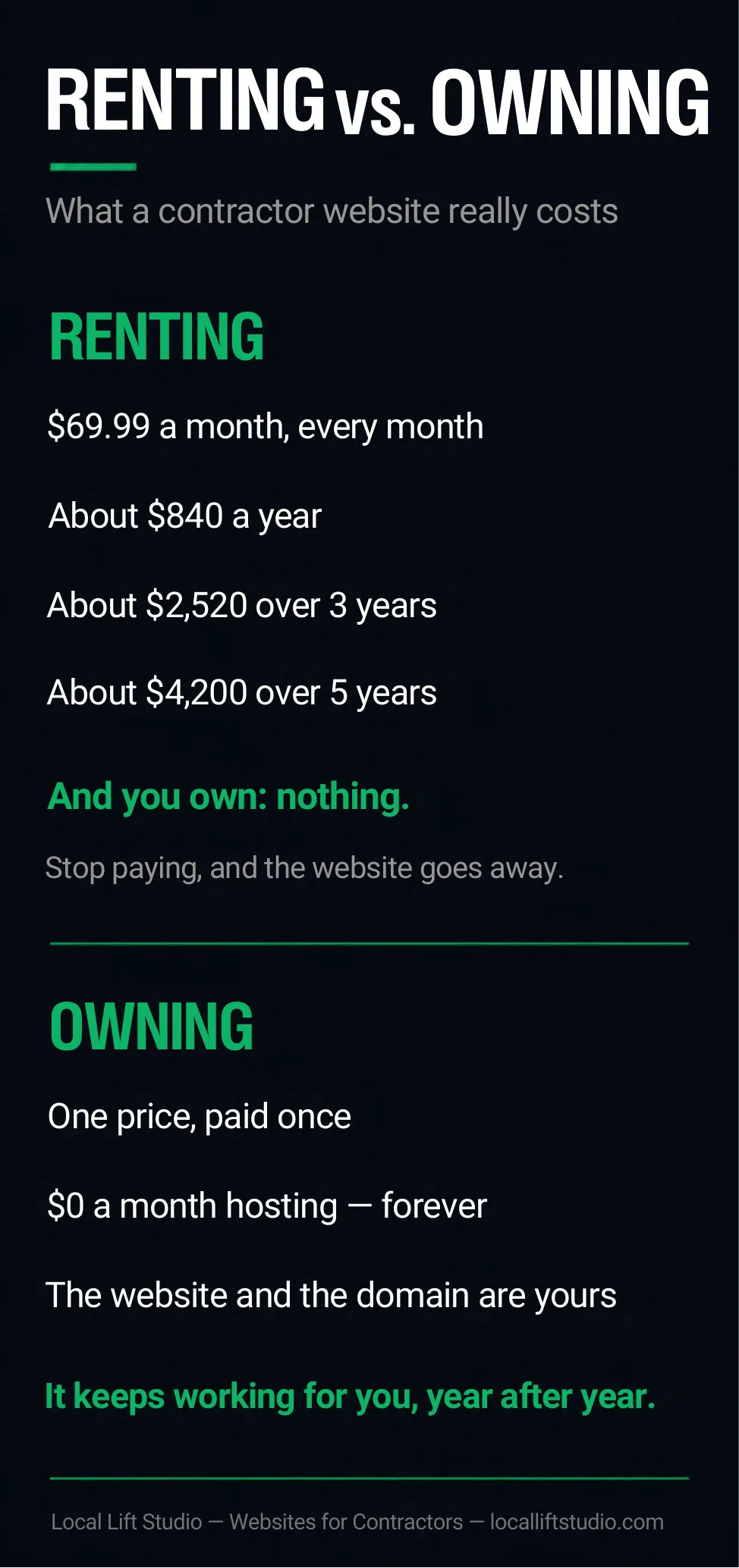
If your website comes with a monthly payment that never ends, you don't own a website — you're renting one. And renting adds up faster than most owners realize. One real rented site we audited here in North Carolina runs $69.99 a month. Over three years that's about $2,520 paid out — and at the end of it, the owner owns nothing. Stop paying, and the website goes away.
Run the math the way you'd run any job
Contractors understand rent versus own instinctively. You'd never rent the same truck for ten years and call it yours. But websites get sold the other way — a low monthly number that sounds painless.
$69.99 a month is $840 a year. That's $2,520 over three years, roughly $4,200 over five, and it never stops, because there's no payoff point. Year six costs the same as year one. Meanwhile the site itself — the pages your customers read, the photos of your work, the reviews you earned — sits on somebody else's platform. We see this pattern constantly in audits across Johnston County: good-looking site, healthy business, and the deed to the whole thing belongs to the company collecting the rent.
To be fair, there's a reason smart owners sign these deals. The upfront cost is low, the site looks professional, and somebody else handles the technical side. None of that is foolish. The problem isn't the look of the site. The problem is what you hold when the payments stop — which is nothing.
What "rented" actually means day to day
Ownership isn't a technicality. It changes what you can do:
- If you leave, you start over. A rented site can't be picked up and moved. The design, the pages, and often your photos live inside their system. Walking away means rebuilding from zero.
- Changes go through them. Want a new service page before storm season, or your phone number fixed? You're in their queue, on their timeline, sometimes at their extra charge.
- Your Google presence is tied to an address you don't control. The longer a site is live, the more trust it builds with Google and with customers. On a rented site, that trust is attached to a property you can lose the day you cancel.
- It's an expense forever, never an asset. An owned website is part of what your business is worth. A rented one is a bill.
A Facebook page is the same arrangement, by the way — borrowed ground that can change its rules or go dark without asking you. We put the page and a website head-to-head in Part 5 of this series: which one actually books jobs.
What owning changes
When you own your website outright, the math flips. You pay once to have it built. Hosting — the thing the rent is supposedly covering — costs us nothing to pass on, so we charge $0 a month for it, forever. The site and the domain are in your name. If you ever want small updates handled for you, that's an optional extra you can take or leave — not a condition of keeping your site online.
That's the whole model behind our pricing: one price, paid once, and the website belongs to the business that paid for it — the same way your truck and your tools do. We're based in Clayton and we build for roofers, HVAC companies, and remodelers across Johnston County, because local owners keeping their work — and their websites — in the community is the entire point.
Check your own situation
Here's a thirty-second test. Ask yourself three questions. Is there a monthly website payment on my card that never seems to end? If I cancelled it tomorrow, would my website still be there next month? Is my domain name registered to me, or to the company that built the site?
If any of those answers worries you, it's worth knowing exactly where you stand. We run a free website audit for local contractors — no pitch, just a straight answer on whether you own your site or rent it, what it's costing you, and what your options are. Read it, sit with it, and decide for yourself.
Does it make sense to keep paying rent on the one salesperson your business has working around the clock? We don't think so — and now you have the numbers to judge for yourself.