Website vs Facebook page: which one books jobs?
By Antionne Gartrell — Local Lift Studio, Clayton, NC · November 20, 2026
Listen to this article· about 5 minutes
Read aloud by Local Lift Studio — for the drive between jobs.
Watch: Website vs Facebook Page: Which One Books Jobs?· 7:12
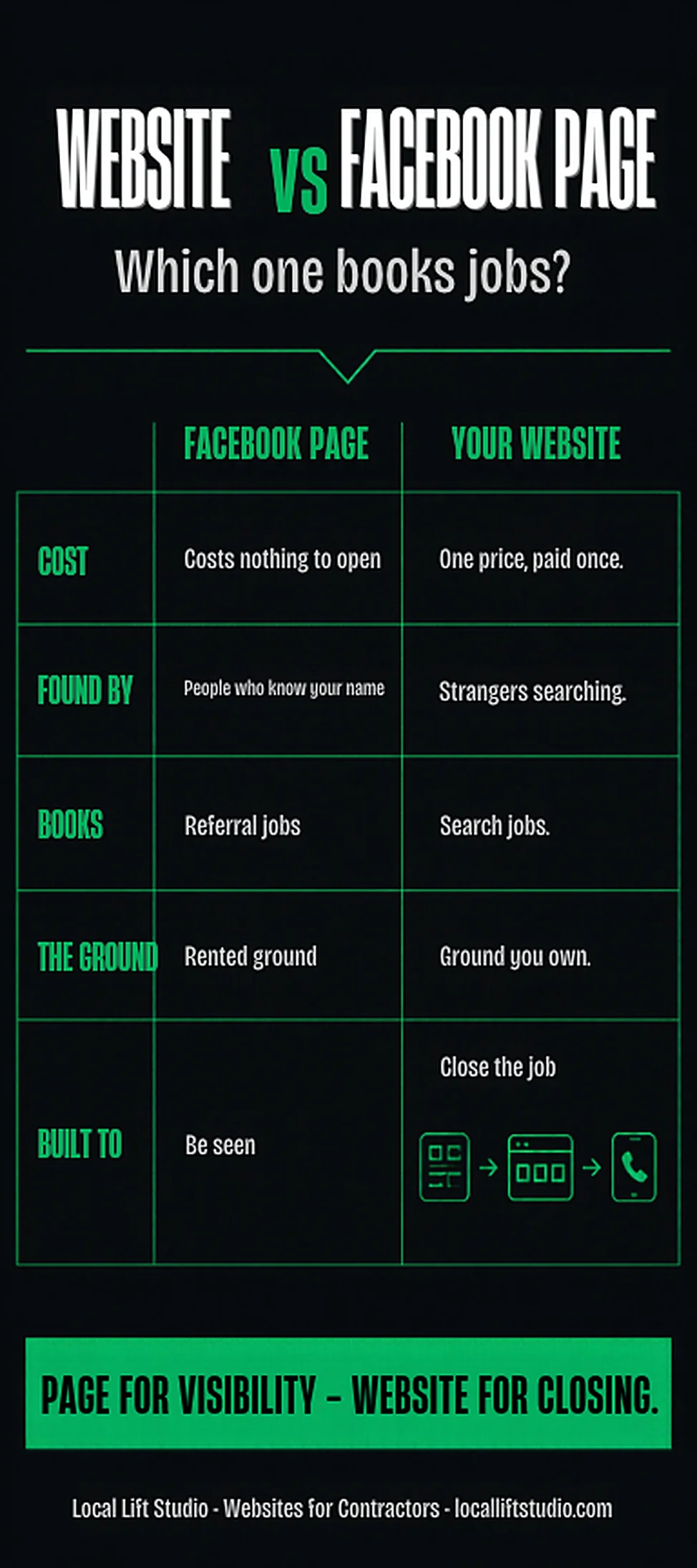
Both book jobs — but they book different ones. Your Facebook page books people who already know your name; your website books strangers at the moment they search. The honest verdict isn't page or website — it's page and website, each doing the job it's good at.
Where does Facebook genuinely win?
Let's give the page its due first, because it earns it. A Facebook page costs nothing to open and takes about ten minutes to set up. Your customers are already there, scrolling tonight. You can post photos from the truck the minute a job wraps. People can message you in one tap, and plenty of them prefer it that way.
Your reviews live on the page where neighbours can see them. And the community groups — the Johnston County groups where someone asks, "Who does good roofs around here?" — are Facebook's home turf, and a page lets you show up there as a business. For a contractor starting out or running on referrals, the page is a genuinely good tool. The rest of this only matters if that part is honest.
Where does the shortlist actually form?
Now picture a homeowner in Smithfield. A storm comes through and there's a drip over the kitchen table. Or it's July in Clayton, the air conditioning just quit, and the house is climbing past eighty. She doesn't open Facebook and browse — she opens Google and types "roofer near me" or "AC repair Clayton."
In the next few minutes — before she calls anybody — a shortlist forms: two, maybe three names. Google shows her a map with a few businesses, star ratings beside their names. That's the shelf she shops from. Here's the problem for a page-only business: a Facebook page gives Google almost nothing to read, rank, and put in front of her. Your page might appear if she searches your exact business name — but she doesn't know your name yet. That's the whole point.
Your page can absolutely be her second click — the place she checks that you're real, current, and neighbourly. It's a fine second click. It just can't be the first one, because the first click belongs to whoever Google could find.
What about the ground each one stands on?
One beat on ownership, because it belongs in any honest comparison. Your page sits on rented land: the platform sets the rules, and if you ever leave, the followers don't come with you. A website you own is the opposite arrangement — your name, your pages, your ground. We covered that ground in full in Part 1, on renting vs. owning, so we'll leave it there.
Which jobs does each one actually book?
Your page books the jobs that start with your name: the neighbour who saw your truck, the past customer sending her sister your way, the group member who remembers last month's post. That's real work, and the page is good at it — as long as people keep remembering you exist.
Your website books the jobs that start with a problem: the leak, the dead AC unit, the kitchen that's finally getting redone. Those homeowners search, form that shortlist, and call two or three names. If you're not findable in that moment, those jobs go to whoever is — whether you hear about them or not.
And a page can show your work, but it can't really take the job. There's no estimate path at 11 PM, no service pages for each town you cover, no one screen where a ready-to-buy customer finds your prices, your proof, and your phone number together. A page is built to be seen. A website is built to close. It's also why we publish our pricing the way we do — one price, paid once.
Try it with your own numbers. Think of your last ten jobs and ask where each one started. Odds are the referrals and repeats trace back to people who already knew your name. Now ask the harder question: how many searches happened in your towns this month, for exactly what you do, that you never heard about? You can't count them — and that's precisely the point.
The verdict: keep the page loud, let the website close
Neither — you keep both, and you let each one do its job. Keep the page loud: job photos, reviews, community groups, the neighbourly presence. That's your visibility and your personality. Then let the website do the closing: show up when strangers search, prove you're the real thing, and give them one next step. That is the entire point of web design in Clayton done right — not a prettier page, but a findable one. The page feeds the site, and the site closes the job.
If you can only fix one thing this month, start where you're weakest. All page and no website means you're invisible at the exact moment money changes hands. That's the gap worth closing first.
Not sure where you're findable — and where you're not?
That's a fair thing to want to know before you spend anything. We run a free website audit for Johnston County contractors — a straight answer on where you show up when strangers search and what to fix first. Read it, sit with it, and decide for yourself. Does it make sense?