First to Respond Wins the Job: Missed-Call Text-Back, After-Hours Cover, and the 5-Minute Rule
By Antionne Gartrell — Local Lift Studio, Clayton, NC · November 24, 2026
Listen to this guide· about 6 minutes
Read aloud by Local Lift Studio — for the drive between jobs.
When a homeowner reaches out, answer inside five minutes — by text first — or accept that someone else is probably getting the job. In Modernize's 2026 Homeowner Insights, drawn from more than 240,000 homeowner inquiries, 51% of homeowners said they prefer text for first contact with a contractor — up sharply from 29% just a year earlier. Email came in at 22% and phone calls at 20%. The homeowner has already chosen how she wants to talk to you. The only question left is how fast you answer.
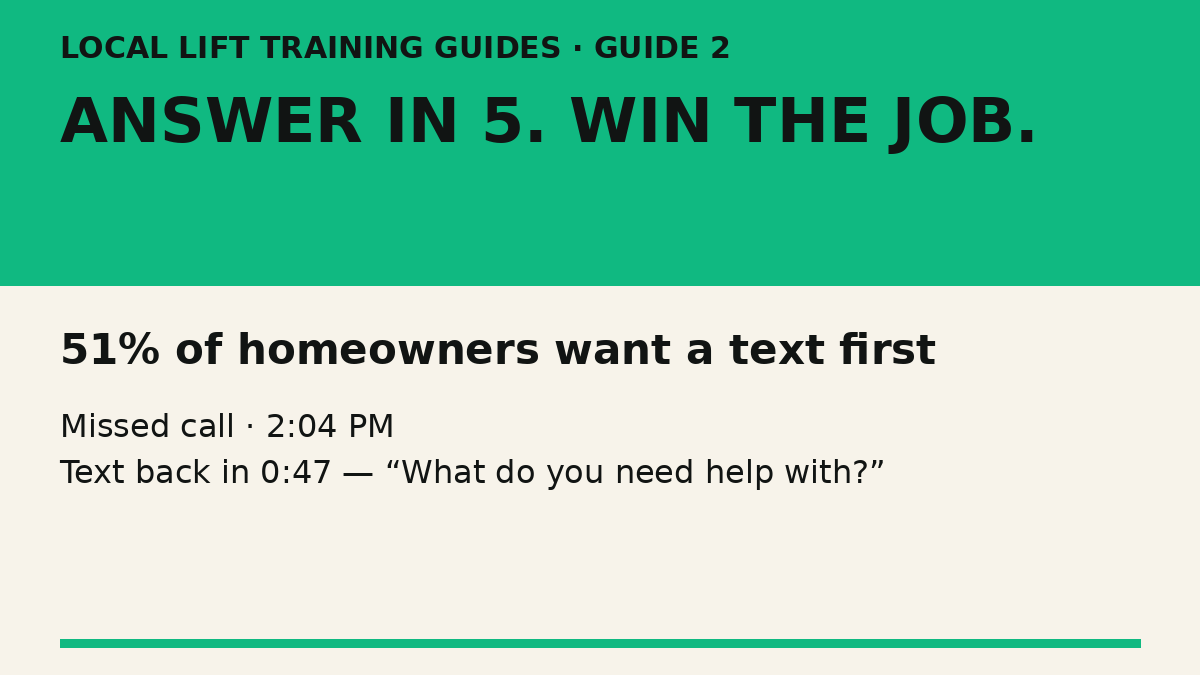
Homeowners have gone text-first. Has your shop?
A year ago, texting was the preference of fewer than one in three homeowners. Now it's the majority — more than email and phone combined. This isn't a quirk of one survey's wording: the same report shows what homeowners hold against contractors when they decide not to hire. The top two reasons are tardiness (17.4%) and poor communication (17.2%) — ahead of price complaints. Slow and silent reads as unreliable, and unreliable doesn't get the job, however good the work is.
Be honest about what this guide will not do: it will not quote you the dramatic multipliers that software companies use to sell call-tracking tools — the "you're 21 times more likely" claims and the dollar value supposedly attached to every missed call. Those numbers trace back to old or vendor-run studies, and we couldn't verify them at the source, so they're not printed here as fact. What the verified data does say is enough: homeowners prefer text, they punish slow replies, and most of your competitors are still letting the phone ring out while they're under a house. You don't need a multiplier to act on that. You need a system.
The 5-minute rule
Here is the working rule this guide teaches — our standard, stated as a standard, not a statistic: every new inquiry gets a human-meaningful response within five minutes during the hours you're awake and working, and an automatic holding response the rest of the time.
"Human-meaningful" matters. An auto-text that says "Thanks, we got it, we'll be in touch" buys you honesty points but not much time. A response that names the problem back — "Got it, no heat since this morning, is the house getting cold?" — tells the homeowner a person is on it. The automatic message's job is to open the conversation and ask the one question that matters. A person's job is to pick it up from there, fast.
Why five minutes? Because that's the window while the homeowner is still standing in the kitchen with her phone in her hand, still on your page, still deciding. An hour later she's had two other conversations. You don't need a study to know which call you'd rather be.
The four pieces of the system
1. Missed-call text-back. When a call goes unanswered, your phone system immediately texts the caller. This is the single highest-value piece for a small shop, because the missed call is structural: you're on a roof, in a crawlspace, or driving between jobs when homeowners call. The text goes out while you're still up the ladder:
"Sorry we missed your call — this is [Business Name]. What are you needing help with? Text back here and we'll get right on it."
One text. No links she didn't ask for, no marketing. Just an open door and a question.
2. The web form that texts back. If your website has a contact form, its submission should trigger the same immediate text, not just an email to an inbox nobody checks until evening. Email is where inquiries go to wait; text is where they get answered. (If your site has no form — or no site — that's a bigger leak, and it's covered in why your website isn't getting calls.)
3. After-hours cover. Evenings and weekends are when homeowners are home, noticing problems, and doing research. Cover doesn't have to mean a person on duty. It means: the missed-call text-back runs around the clock, your voicemail greeting promises a reply by a specific time ("We'll text you back tonight or first thing by 8 a.m."), and somebody owns the first sweep of the morning. A promise with a time on it keeps; a vague "we'll get back to you" doesn't.
4. The next-morning sweep. Before the first truck rolls, one named person checks every channel — missed calls, texts, form submissions, Google messages — and works the list until it's empty. Ten minutes. This is the piece that catches everything the other three missed, and it's the piece most shops skip because it belongs to nobody. Give it a name, not a hope.
Your speed-to-lead checklist
Set this up once; it runs every day after:
- Turn on missed-call text-back on your business line, with the template above in your own words.
- Connect your website form to an instant text-back, not just an email notification.
- Write the 5-minute rule down where the whole shop can see it — who answers first, who backs them up.
- Re-record your voicemail greeting: name the business, promise a text-back and a time.
- Set the after-hours rule: auto-text on, every night, every weekend.
- Name the morning-sweep owner and the backup. Put the sweep on the calendar like a job — because it is one.
- Test it yourself: call your own number from your personal phone, let it ring out, and time what happens. Do the same with your website form.
- Once a month, pull your missed-call count. If it's climbing, the problem isn't the system — it's cover during work hours, and that's a staffing conversation worth having with the numbers in front of you.
What this looks like in Johnston County
Picture a plumbing owner in Smithfield — an illustrative example, not a real business. He's under a house at 2 p.m. when a homeowner in Benson finds his Google profile and calls. The call rings out; the text-back fires before she's finished listening to the voicemail greeting. She texts a photo of the water heater and "no hot water since yesterday." At the next break he replies from the driveway — a real reply, inside the hour, to a conversation that's already warm — and books the first slot next morning. The competitor she called second answered at 6 p.m. to a job that was already taken. Nothing about that story needs software more exotic than a business phone line with text-back switched on. It needs the switch flipped and the sweep owned.
Speed is a system, not a personality trait
Some owners are fast because they're glued to the phone; most aren't, and shouldn't have to be. The shops that answer in five minutes do it with four boring pieces of setup, not with hustle. If you want to see how your current setup looks from the homeowner's side of the glass — what she sees in the first two minutes before she ever calls — start with a free website audit. We'll walk your site and your contact paths with you and show you where the leaks are. Fixing them is your call.
Sources
- Modernize, 2026 Homeowner Insights — "Contractor Research, Communication and Payment Trends," based on 240,000+ homeowner inquiries (Aug–Oct 2026): 51% prefer text for first contact (up from 29% in 2025); email 22%; phone 20%; top reasons homeowners won't hire: tardiness 17.4%, poor communication 17.2%. modernize.com
- Note on figures deliberately not used: vendor-circulated claims (response-time multipliers, per-missed-call dollar values) were checked and could not be verified against a primary source, so they are not stated as fact anywhere in this guide.