The Pricing Page That Gets the Call: Ranges, Fees, and What Moves the Price
By Antionne Gartrell — Local Lift Studio, Clayton, NC · November 24, 2026
Listen to this guide· about 6 minutes
Read aloud by Local Lift Studio — for the drive between jobs.
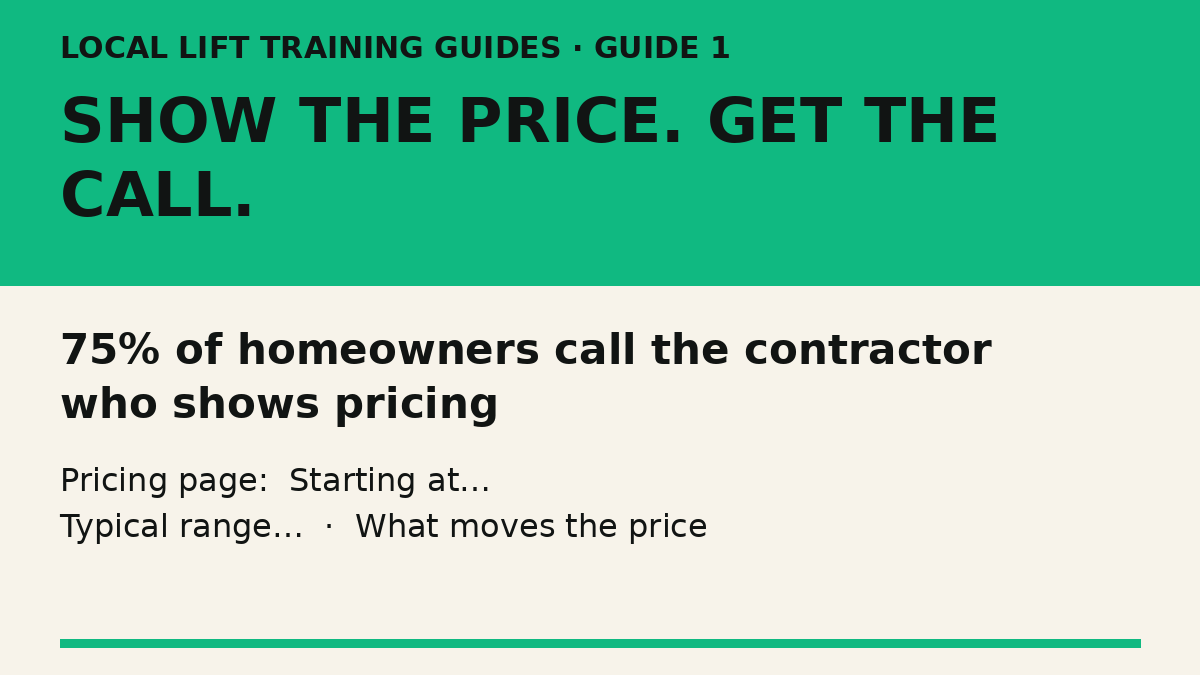
Put an honest price range on your website and more homeowners will call you — and the ones who call will already know roughly what the job costs. In a 2026 homeowner study, about 75% of homeowners said they are more likely to call a contractor who displays pricing, yet only about 24% of contractors put any prices on their websites at all. That gap is the whole opportunity: the first question every homeowner asks is "what will this cost?", and most of your competitors refuse to answer it until they're standing in the kitchen.
Why do homeowners go quiet when there's no price?
Because no price reads as a warning. A homeowner who can't find any number assumes the worst — that the number is high and you're saving it for the sales pitch. So she does the safe thing: she calls the next company on the list, the one that gave her something to work with.
Scott Merritt, co-founder of Honest Fix, an HVAC company in Steubenville, Ohio, publishes price ranges for virtually every type of equipment he installs. His pricing page is the most-viewed page on his website. His reasoning is worth taping to the office wall: "It's people's first question… You have to address it in some way and give them some kind of range."
Notice what he's not doing. He's not quoting exact prices online. He's giving a range, in writing, before the phone rings — and that one page outdraws everything else he publishes.
The gap between what homeowners expect and what the job costs
Here's the second problem a pricing page solves. In the same study, about 45% of homeowners expected a full system replacement to cost less than $7,500 — while contractors reported typical prices of $10,000 to $15,000. (This was an HVAC study, so read those dollars as heating-and-cooling numbers; the pattern — homeowners anchored well below the real price — is the part that applies to roofing and remodeling tickets too.)
When that gap first shows up in the homeowner's living room, you spend the visit defending your price instead of explaining your work. When it shows up on your website, the homeowner closes the gap herself, at her kitchen table, on her own time. She calls already knowing the neighbourhood the price lives in. That's a different conversation — and a shorter one.
What exactly should go on the page?
Four pieces. Every trade can fill them in.
1. Your diagnostic or trip fee, stated plainly. What it costs to get you to the door, and what that fee covers. If the fee is credited toward the repair, say so. A stated fee filters out the calls that were never going to pay one — and it tells serious homeowners you're a real business with a real process.
2. A "starting at" price for your most common jobs. The floor, honestly labelled: "Water heater replacement starting at…" A starting-at price is a promise about the simplest version of the job, and it should be a price you have actually charged.
3. A typical range for the big tickets. This is the Merritt move: a range wide enough to be honest, narrow enough to be useful. "Most full system replacements we install run $10,000–$15,000" is HVAC's version from the study above — write your own version from your own last twenty jobs, not from anyone's article, including this one.
4. What moves the price. A short, plain list: size of the home, condition of what's already there, access, materials chosen, code or permit work. This list does quiet, heavy work — it teaches the homeowner that the range isn't a trick, it's a description of her house. It's also the part that makes your final quote believable, because she heard the reasons before she saw the number.
Then close the page with the promise that makes ranges safe: the exact price is confirmed in writing before work begins. A range gets the call. A written quote gets the signature. Nobody is asking you to be bound by a website range — you're asking the homeowner to start the conversation informed instead of suspicious.
What should you leave off?
- A fake lowball. A "starting at" price no job has ever actually hit is bait, and homeowners smell it. It also poisons the visit: you opened by disappointing her.
- "Call for pricing" as the whole page. That's the 76% strategy — it's what most contractors do, and it's why the ones who publish stand out.
- An exact quote online. You haven't seen the house. Ranges are honest precisely because the exact number depends on the job — say that, in those words.
A quick distinction, because owners mix these up: this guide is about the prices you charge homeowners for your work. What a website should cost is a different question, and we answered that one separately — see how much a contractor website should cost in North Carolina.
Your pricing page checklist
Do this in one sitting, from your own invoices:
- List your five most common jobs. Pull the last 10–20 invoices for each.
- For each job, write the real low, the real typical, and the real high. Use your numbers only.
- Write your diagnostic/trip fee and exactly what it covers.
- Write the "what moves the price" list for each big-ticket job — five factors, plain words.
- Add the written-confirmation promise: exact price in writing before work starts.
- Put the page where homeowners can find it: linked from your homepage and your service pages, not buried in a footer.
- Re-check the ranges twice a year, or whenever your supplier prices move. A stale range is worse than none.
- Run your current website against the free Website Cost Worksheet to see what your site itself is costing you while you work on what it says.
What this looks like in Johnston County
Picture a two-truck HVAC shop in Clayton — this is an illustrative example, not a real business. The owner pulls his last fifteen change-out invoices on a Sunday night. The honest range writes itself: most landed in a band he can defend, with the high ones explained by ductwork and access, and he lists exactly those two factors under "what moves the price." His diagnostic fee goes at the top of the page with one line — credited toward the repair. Nothing on that page is a sales pitch. It's the answers to the questions every Smithfield and Benson homeowner was going to ask him anyway, given before the call instead of during it. The homeowners who ring him on Monday already know the range and the reasons. The ones who were never going to pay it don't ring — and that, for a two-truck shop, is also a win.
Start with what you already have
You don't need a new website to do this. You need one page, your own invoice history, and the willingness to answer the first question first. If you'd like a second set of eyes on how your current site handles price — or on the leaks that stop it getting calls at all — start with a free website audit. We'll show you what a homeowner sees when she lands on your site today, and you decide what to fix first. No pitch, just the findings.
Sources
- ACHR News, "What Homeowners Expect When They Call an HVAC Contractor" (Nov 17, 2026), reporting the myCLEARopinion Insights Hub Homeowner Study — 75% more likely to call a contractor displaying pricing; 24% of contractors display prices; ~45% of homeowners expect a full replacement under $7,500 vs. typical contractor-reported $10,000–$15,000; Scott Merritt (Honest Fix, Steubenville, OH) quote and most-viewed-page account. This is an HVAC study; figures are labelled as such in the text. achrnews.com